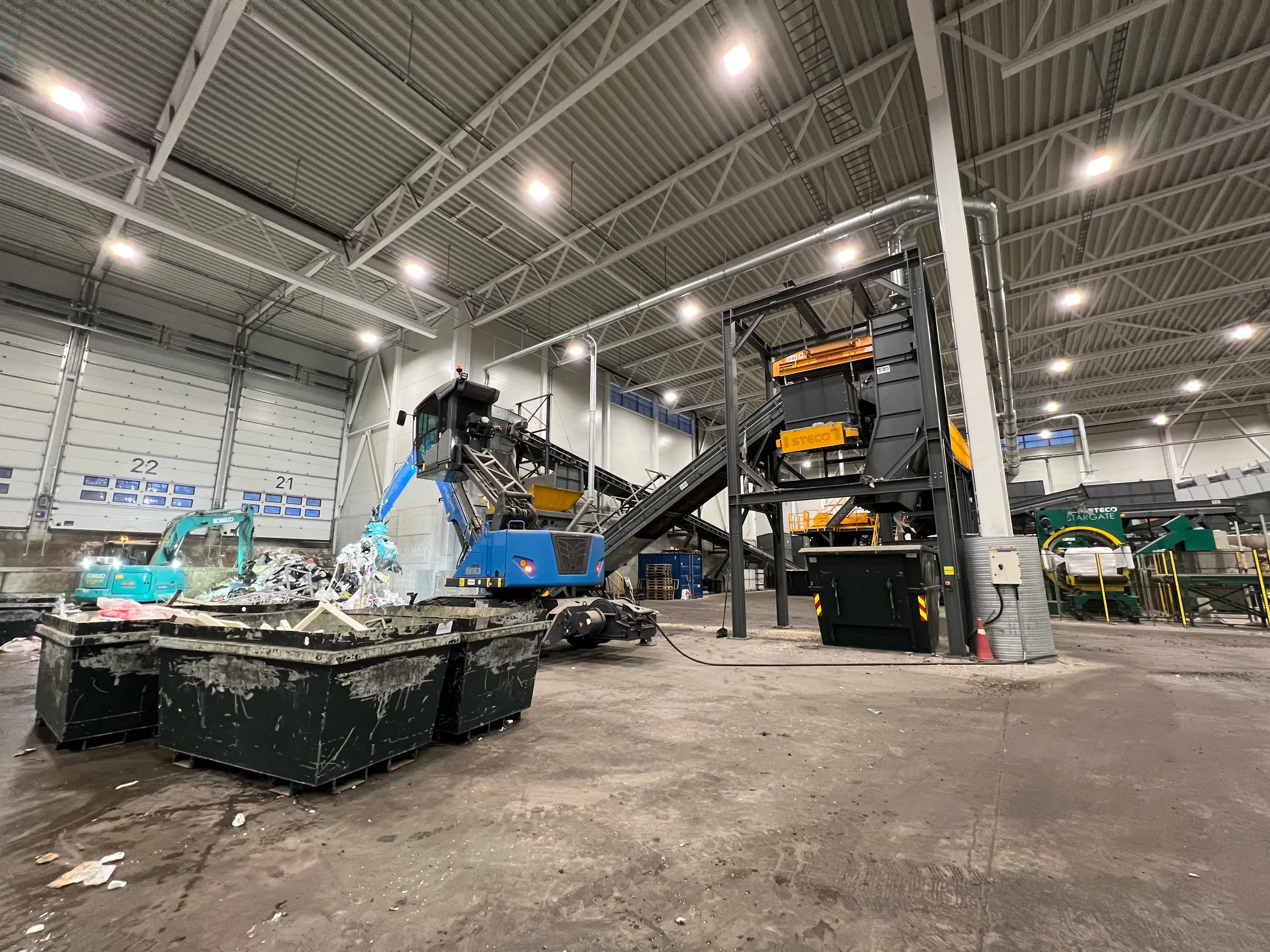
Waste plants — everything you need to know, from one machine to a complete line
Practical technical guide for Norwegian waste and recycling plants: scale, conveyors, mechanical separation, optical sorting, robotics, data capture — and what most people forget about the Machinery Directive and Declaration of Conformity.
Contents
- Introduction
- Scale: from simplest setup to full line
- How the line is structured
- Conveyors — the backbone of the plant
- Mechanical separation — upstream steps that pay off
- Optical sorting with NIR
- Robotic sorting and AI
- Data capture and analysis
- The intelligent sorting line
- Safety, compliance and plant construction — what most people do not ask about until it is too late
- Maintenance and service life
- The way forward
- Related product overviews
In brief
- Plants are built in stages. Start with a shredder, feed conveyor and magnet — add screening, optical sorting and robotics as volume and requirements grow.
- Don’t skip the upstream steps. Basic screening and magnetic separation first give better results than a single advanced optical sorter alone.
- Conveyors are the backbone. The right belt type — trough, flat, steel or chain — determines capacity, maintenance and uptime.
- NIR, robots and AI complement each other. NIR handles throughput; the robot handles fine-sorting and quality control.
- What many forget: if you rebuild the plant yourself, you become the machine builder and take on the conformity responsibility (CE and the Machinery Directive).
Introduction
A “waste plant” is rarely just one machine. It is a chain of process steps where material moves from receiving, through pre-processing, separation and precision sorting, and out again as clean fractions ready for the offtaker. How many stages you need, and how advanced they should be, depends on the material stream, the quality requirements from offtakers and what the economics can support.
This guide is written for those considering building new, upgrading existing lines or simply wanting to understand what the various components do. We cover the range from the simplest setup — a shredder, a feed conveyor and a magnet at a small receiving facility — to full-scale MRF (Material Recovery Facility) and post-sorting plants with multiple optical sorters, robots and continuous data capture. Most likely you are somewhere in between, and the most important thing is to understand where you are and what the next sensible step is.
We also address an area that many underestimate until it becomes a problem: the Machinery Directive, safe access for maintenance, and what happens to the Declaration of Conformity when you rebuild the plant yourself. It may not be the most exciting part, but it is the one that can cost the most if it goes wrong.
Scale: from simplest setup to full line
There is no “right size” for a waste plant. Capacity is governed by the shredding and sorting equipment, not by the number of stages — a single shredder can run at 100 t/h, and a complete sorting plant can run at far less. The right setup for you depends on the material stream, the quality requirements from offtakers and what the economics can support.
The simplest practical setup is a shredder, a feed conveyor and a magnet at a smaller receiving facility or an industrial company pre-processing its own waste. The next step is often to add screening (star screen, trommel or flat screen) to remove fines and oversize, and optionally air classification for light fractions. With a baler at the output you have a complete receiving operation that takes in, pre-processes and packages material for transport.
As volumes and requirements grow, optical sorting with NIR, multiple parallel lines, inspection cabins for manual post-sorting, and eventually robotic sorting, AI and data capture come into play. A full MRF or post-sorting plant has dozens of machines working together.
The point is not to fit into a particular level, but that plants are built incrementally. Most start simple and add capacity and precision as volumes and requirements increase. The technology is largely modular: a line that has space for a NIR sorter later can be ready for that from day one.
One important caveat: do not skip the upstream steps. A plant that tries to solve everything with one advanced optical sorter, but does not have basic screening and magnetics upstream, will produce worse results than a level-2 plant that has its basic mechanical separation in order. More on this below.
How the line is structured
A complete plant broadly follows this flow — and your version will be part of it:
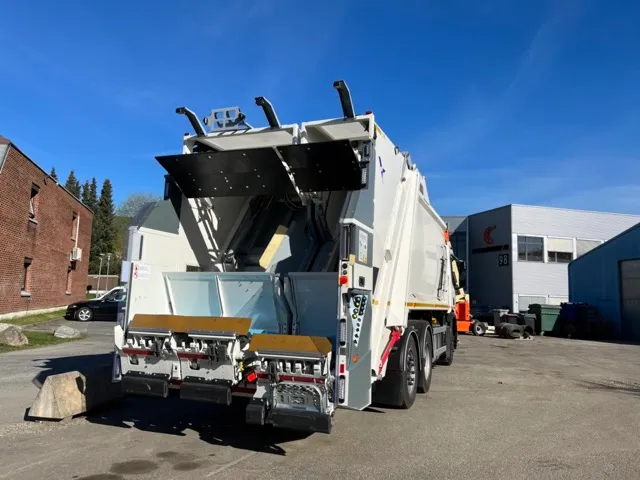
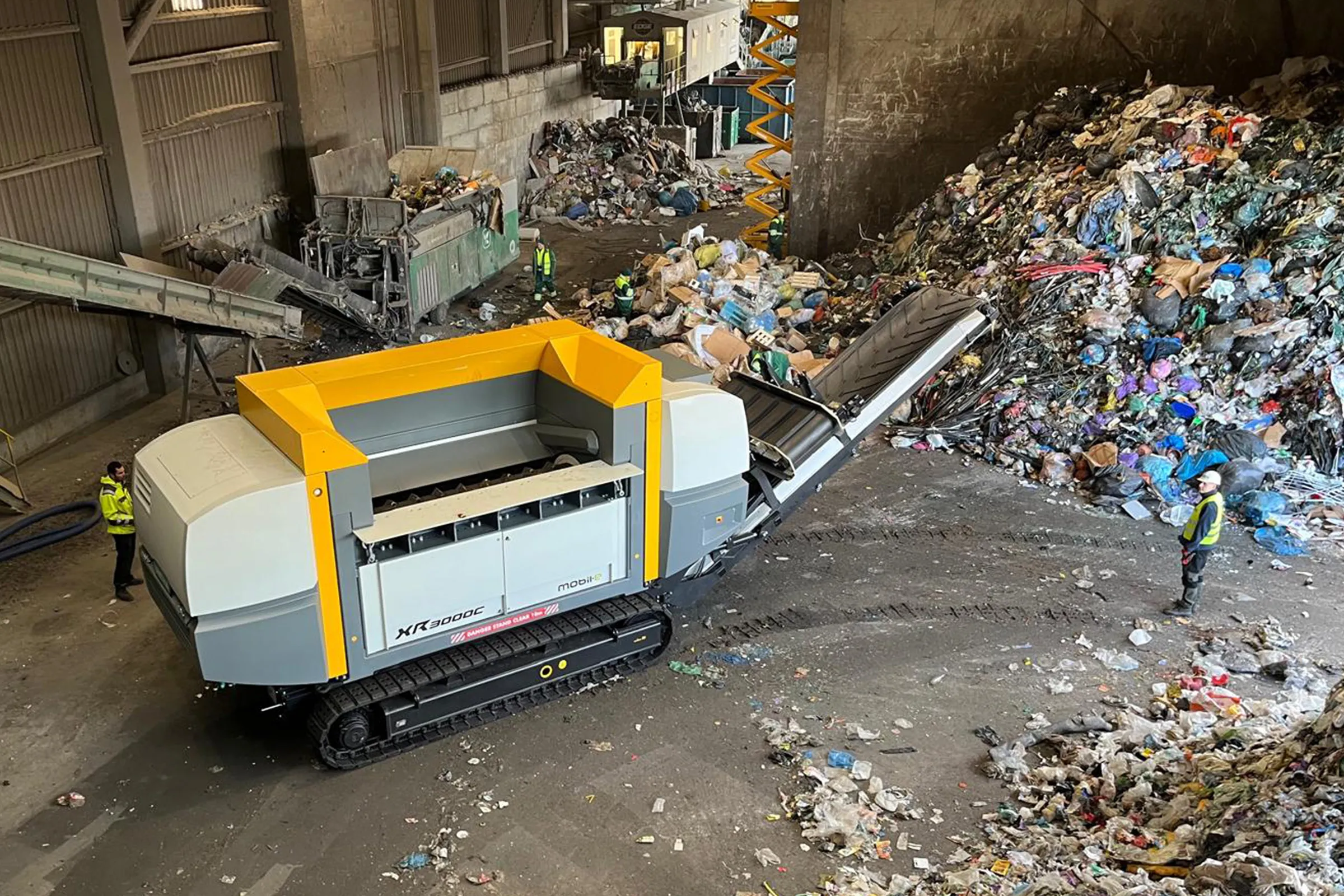
- Receiving and pre-processing. Waste arrives by wheel loader, hook-lift or container. Here you do initial rough sorting, remove obvious contaminants and shred material down to a size the line can handle. See the shredder section for shredder selection.
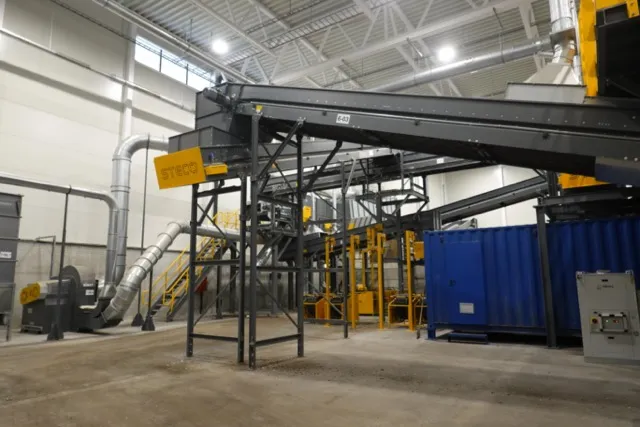
- Transport. Between each stage, conveyors move the material forward. The conveyor type you choose has a major impact on capacity, maintenance and operational reliability — see the dedicated section below.
- Mechanical separation. Screens, magnets and air-based separation remove coarsely what should not proceed. This is the upstream step that makes precision sorting possible.
- Precision sorting. Optical sorting (NIR), optionally with robotics and AI on top, extracts saleable fractions at high purity.
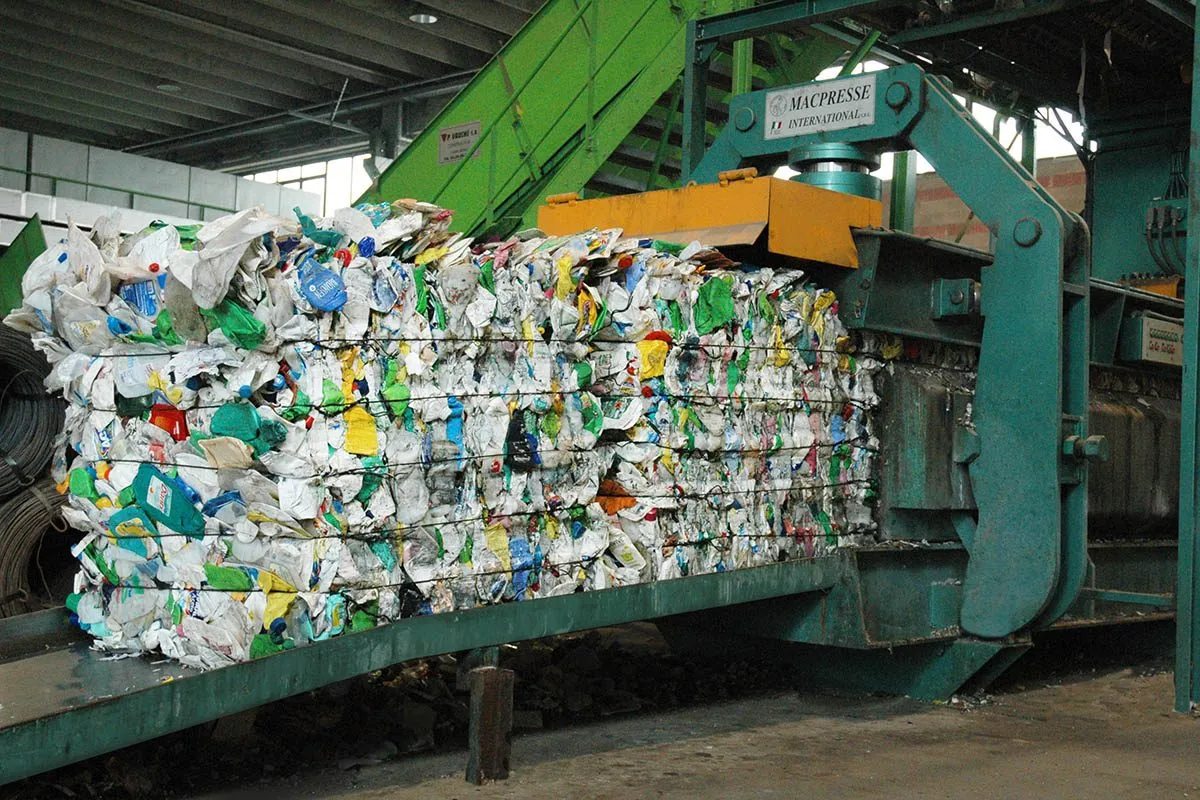
- Outloading. Balers compress fractions for transport. See the baler section for selection guidance.
Mobile solutions (see mobile recycling equipment) can cover parts of this flow where you do not have a stationary plant, for example on demolition sites or temporary receiving operations.
Conveyors — the backbone of the plant
When do you need this? All plants. Even the smallest setup has a feed conveyor between shredder and containers. On larger plants we are talking dozens of metres of conveyor for different purposes — feeding, inter-stage transport, sorting conveyors, outloading.
In the waste industry the requirements for conveyors differ from most other industries. The material stream is unpredictable: one moment plastic and cardboard pass through, the next a metal piece or concrete chunk. Belts must withstand impacts, wear and contamination — and be quick to maintain, because downtime is costly.
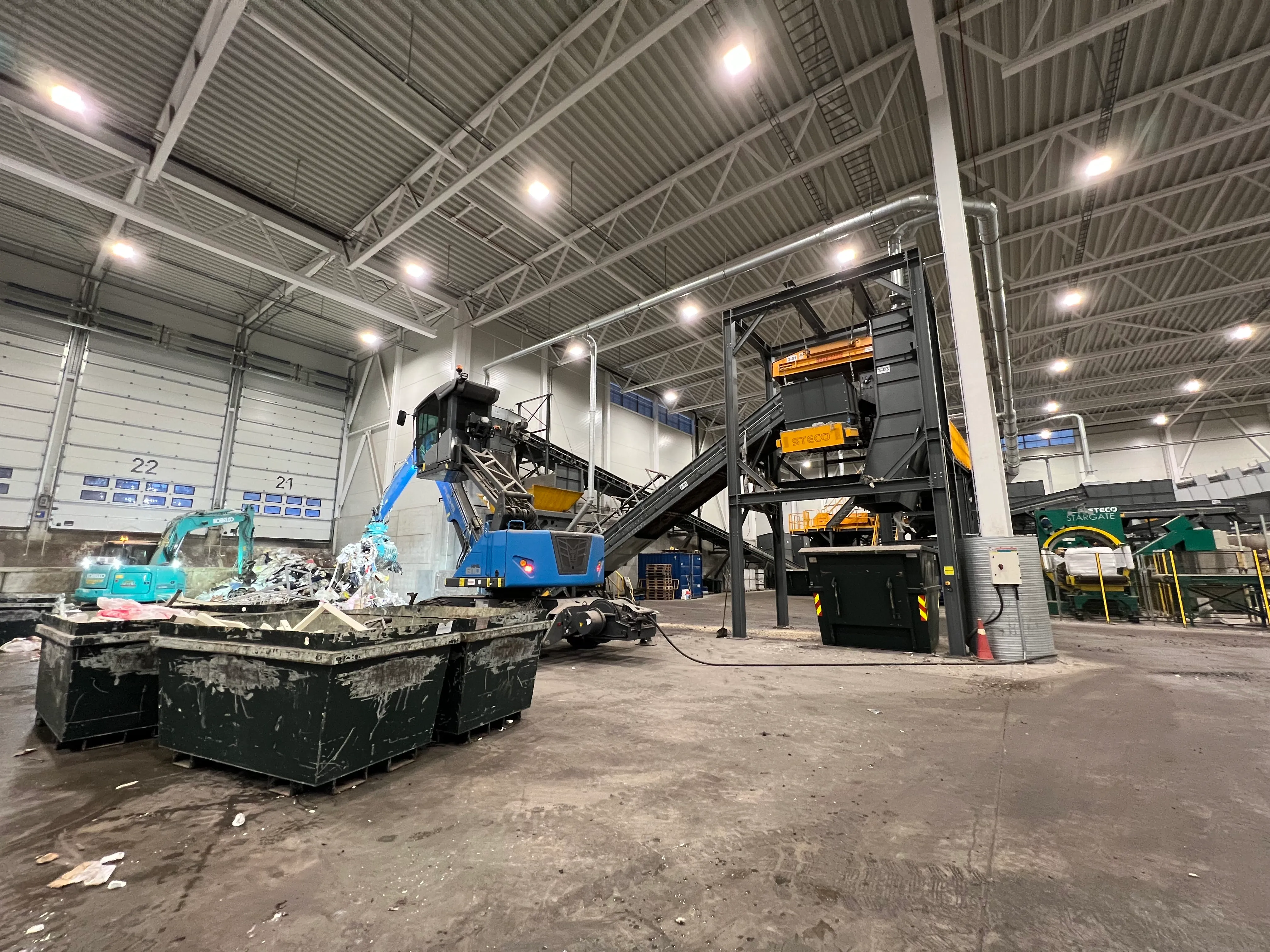
The four main types
Trough conveyors. The workhorse in most plants. The belt is shaped into a trough profile by angled idlers, typically 3-roller with 20°, 30° or 35° angles. The trough shape increases carrying capacity and keeps material centred. Suitable for mixed residual waste, feed conveyors to shredders and screens, and long-distance transport.
Flat belt conveyors. The simplest variant — a flat belt over a slide plate or flat rollers. Ideal as sorting conveyor in inspection cabins and control conveyors after optical sorting, because operators and sensors see the material clearly. Less carrying capacity than trough conveyors and limited inclination angle.
Steel belt conveyors (steel plate conveyors). The most robust variant. The transport surface consists of overlapping steel plates attached to two parallel chains. Withstands impacts from heavy objects such as concrete, metal and stone. Used for receiving coarse and heavy waste — typically under wheel loader feeding, feeding to large shredders and bunker conveyors. High dead weight and higher purchase cost, but extreme service life.
Chain conveyors. A belt attached to two drive chains running in guides. Drive force transmitted via sprockets — positive drive without slip. Widely used for in-floor feed conveyors for wheel loader feeding, outfeed conveyors from bunkers, feed conveyors to balers, and as Z-conveyors with a bend to save a transfer point.
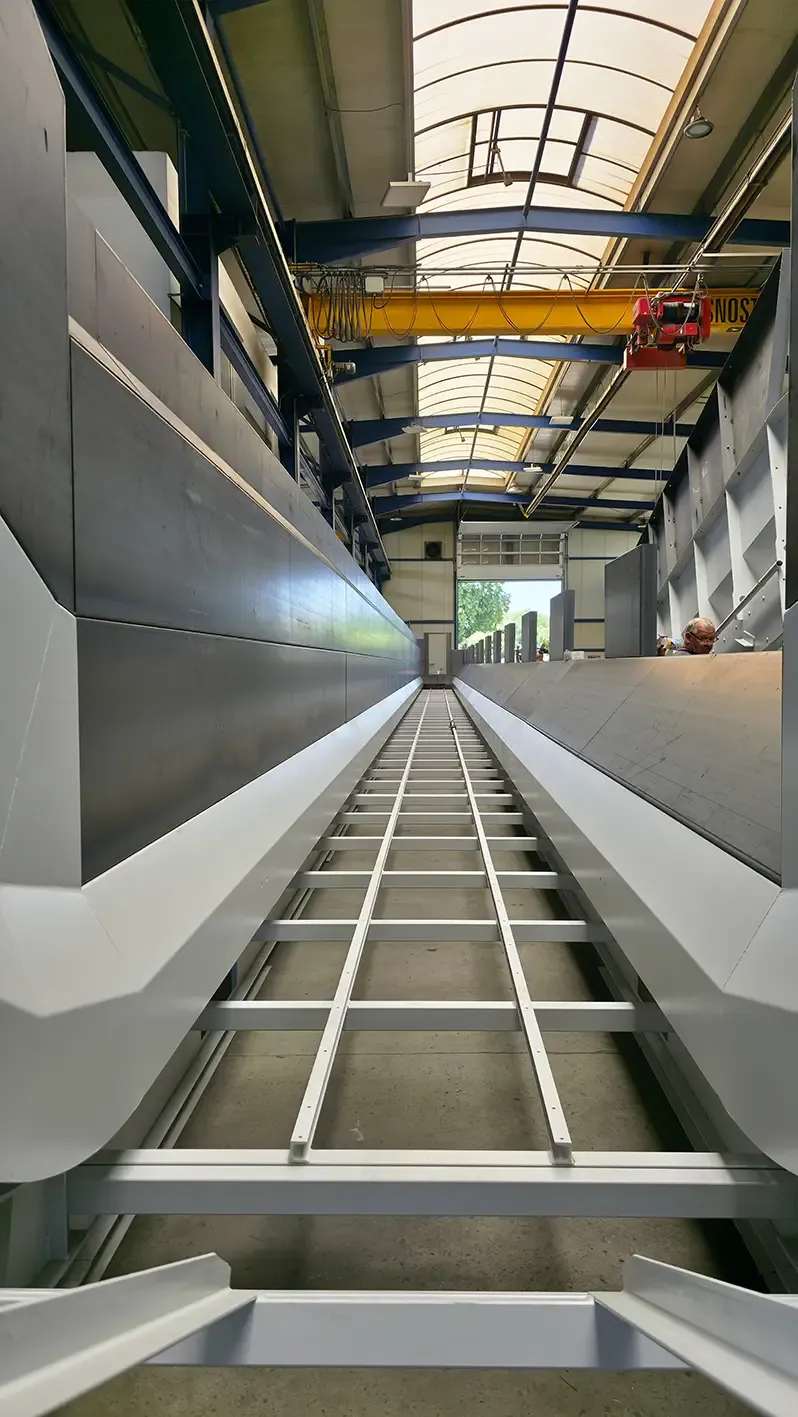
Belt surfaces and inclination angle
Regardless of belt type, the belt surface can be adapted to the material and inclination. The main choices are:
- Smooth: Horizontal transport and gentle inclines up to approx. 15°. Easy to clean, lowest cost.
- Chevron (V-pattern): Inclinations up to 30°–40°. Prevents material from sliding back. Open V lets through water and fines (suitable for wet materials); closed V retains dry fines better.
- Cleats: Steep inclinations up to 45° or for consistent dosing. T-profile, L-profile and corrugated sidewalls with cleats for near-vertical transport.
- Rough/textured: Moderate inclinations of 20°–25° without the disadvantages of profiles that can accumulate dirt.
Quick selection matrix
| Material | Belt type | Belt surface |
|---|---|---|
| Mixed residual waste | Trough conveyor | Smooth or chevron |
| Source-sorted plastic/paper | Flat belt | Smooth |
| Construction and demolition waste | Steel belt or chain conveyor | Steel plates |
| Compost / organic | Trough conveyor | Chevron (open) |
| Scrap metal | Steel belt | Steel plates |
| Material for baler | Chain conveyor or flat belt | Smooth or cleats |
For deeper coverage of a specific belt type, see the technical articles in the blog — trough, steel, chain and belt surfaces each have their own in-depth articles.
Mechanical separation — upstream steps that pay off
When do you need this? Virtually all plants. Even without optical sorting, mechanical separation delivers cleaner fractions and protects downstream equipment — it is often the difference between a setup that delivers and one that keeps stopping.
In practice it is rarely one single unit that solves everything. You get the best results when screening, magnetics and optionally air or density steps are placed where they work best — and when precision sorting comes in only once fractions are ready for it.
Screening and mechanical classification
Screens are used to remove fines (typically sand, soil, small pieces) and to catch oversize that could stop or damage downstream equipment. A good screening stage also evens out feeding.
Main types in the waste industry:
- Star screens: Rotating star-shaped discs on parallel shafts. Self-cleaning, robust for wet and variable material, and give good separation between fines, mid-fraction and oversize. Widely used on mixed commercial waste, compost and demolition waste.
- Trommel screens: Rotating drum with holes of various sizes. Suited to drier and more uniform material, and simultaneously provides a mixing and tumbling effect.
- Flat screens / vibrating screens: Flat screens with vibration, often in multiple layers to divide into several fractions simultaneously. Good for finer fractionation when material is relatively uniform.
Choice depends on the moisture content, shape and how many fractions you want to separate. Star screens are often the first choice when you must handle variable and wet waste; trommels and flat screens have their advantages on specific streams.
Magnetic separation
Overbands and drum magnets extract ferromagnetic material and are often an early, cost-effective measure to protect equipment and prepare for non-ferrous separation later. Higher intensity and wet processes are used where materials and purity requirements demand it.
Eddy current separators for non-ferrous metals (aluminium, copper) typically stand after coarse iron is removed from the stream — otherwise magnetism and mass disturb the balance in the equipment. Steco works with Felemamg among others on magnetic solutions adapted to industry and recycling.
Air and density
Air classifiers and related equipment exploit aerodynamics — useful when separating light from heavy particles after shredding. Density-based separation (in various media) occurs in certain processes; suitability depends entirely on the material stream. These steps often require separate engineering of air volumes, dust control and safety.
Conveyors and separation go together
Magnets and many separators are mounted on, above or immediately after conveyors. Correct feeding and consistent belt speed make separators more stable. This means a well-chosen conveyor is a prerequisite for separation stages to work — not a separate matter.
Optical sorting with NIR
When do you need this? Plants that need to extract saleable fractions at high purity from a complex input material — typically when mechanical separation alone is not enough to meet offtaker requirements.
Near-infrared (NIR) sensor technology is the cornerstone of optical sorting. It identifies materials based on their chemical composition — something neither human vision nor ordinary cameras can do.
How NIR works
A NIR sensor directs infrared light at material on the conveyor. Different polymers and materials absorb and reflect light at different wavelengths, creating a unique “fingerprint”. The sensor analyses this spectrum in milliseconds and classifies the material — for example PET vs. PP vs. HDPE vs. paper — before compressed air jets blow each object in the correct direction. The result is fully automatic sorting at high speed with purity levels typically of 90–98%, depending on application and input material.
Sensor technologies beyond NIR
Modern optical sorters often combine several sensor types in the same machine to cover a wider material spectrum:
- NIR spectroscopy: The core of most sorters — identifies polymers and material types based on chemical composition.
- RGB camera (VIS): Sorts by colour, shape and size. Useful for separating different colours within the same polymer type.
- Laser sensors: Captures materials that NIR cannot detect, especially black plastic and glass.
- Metal detection: Distinguishes metal fractions from non-metals.
- X-ray transmission (XRT): Sorts based on atomic density — important in metal recycling to separate aluminium from heavy metals.
The most advanced sorting lines combine several of these in sequence — for example NIR for main fractionation, supplemented by camera and laser to capture what NIR cannot detect alone.
What defines a good NIR sorter?
Key parameters when evaluating machines:
- NIR resolution: Higher resolution gives better recognition of difficult fractions (PET trays vs. PET bottles).
- Lighting technology: Stable, evenly distributed lighting is critical for consistent quality over time.
- Mounting height: Ability to mount the scanner high above the belt reduces maintenance requirements — dust and particles are constant.
- Throughput: Capacity in tonnes per hour at the desired purity level.
- Flexibility: Possibility of upgrading with additional sensors and software.
- Connectivity: Cloud-based monitoring and reporting for remote support and optimisation.
Robotic sorting and AI
When do you need this? Larger plants where you have specific purity targets or must handle material streams that traditional NIR cannot manage alone (coarse demolition waste, end-of-line quality control, fine sorting of metals).
Where NIR sorters use compressed air to blow objects off the belt, sorting robots use a physical gripper arm guided by AI-based image recognition to pick specific objects.
Three articles in the blog cover these topics more deeply than this guide can: benefits, costs and operational gains from robotisation, how detection and gripper coordinate on the belt, and when to choose a robot arm, other manipulator or compressed air.
How a sorting robot works
Cameras (RGB, optionally hyperspectral) scan material on the belt in real time. An AI model identifies each object — material type, shape, size, colour — and calculates the optimal grip position. A robot arm with suction cup or mechanical gripper picks the object and places it in the correct fraction. Modern sorting robots operate at 40–80 picks per minute per arm, with accuracy of 95% or better. Multiple arms can work in parallel on the same belt.
Applications
Robotic sorting is especially valuable where traditional optical sorting falls short:
- Quality control (end-of-line): Picking residual contaminants at the end of the sorting line — where manual sorting has traditionally been the only alternative.
- Construction and demolition waste (C&D): Sorting mixed building and demolition waste where object size and material variation make air-blast sorting impractical.
- Bulky waste and commercial waste: Heavy, irregular objects requiring mechanical gripping capability.
- Specialised fractionation: Separating material types within one fraction, for example different wood species or plastic types with similar appearance.
Robot vs. NIR — not either/or: NIR handles main fractionation at high throughput, while robots handle quality control, fine-tuning and picking of specific objects — especially at the end of the line.
Traditional AI vs. deep learning
It is important to understand the difference, because “AI” is used broadly in marketing. Traditional AI (rule-based) has been used in optical sorting for several decades — pre-defined rules and threshold values based on sensor data. Stable and predictable, but cannot solve tasks it has not been programmed for. Deep learning is trained on millions of images to recognise patterns that humans can barely describe — such as the difference between food-grade and non-food-grade packaging, or forged and cast aluminium.
In practice, the combination delivers the strongest results. NIR and VIS provide chemical and visual base data, while deep learning adds a layer of object recognition and contextual understanding.
The most important breakthroughs for deep learning in sorting include:
- Food-grade vs. non-food-grade packaging: Visual distinction between food-approved and non-food plastic with purity approaching 95%.
- PET cleaning: Removal of white/opaque packaging, textiles and films from PET bottle streams.
- Aluminium beverage can sorting (UBC): Drink cans from mixed metal packaging with purity above 98% and up to 2,000 ejections per minute.
- Alloy sorting: Cast vs. wrought aluminium alloys as a supplement to XRT.
- Paper and fibre sorting: Office paper, newsprint and magazines with higher precision than colour- or NIR-based methods alone.
A significant advantage of deep learning-based systems is that they can be upgraded with new applications after installation. As material suppliers change packaging or new waste streams emerge, new models can be trained and deployed to existing machines — often over the network.
Data capture and analysis
When do you need this? Larger plants wanting to document quality to offtakers and optimise operation based on actual data. Smaller plants can manage for a long time with manual quality control.
Traditional grab sampling (manual sampling) typically covers less than 1–2% of the waste stream, is time-consuming and costly, and gives only a snapshot. AI-based analysis covers the rest.
What is AI-driven waste analysis?
Waste analysis systems are mounted as camera units above conveyors — typically at multiple points in the sorting line (input, product lines, residual). The AI recognises and classifies each object in real time, aggregating the data to dashboards showing:
- Material composition: What is in the stream, broken down into subcategories (PET bottles vs. PET trays, clear vs. coloured).
- Mass estimate: Estimated weight per object and per fraction.
- Purity and loss: How much recyclable material ends up in residuals, and how much contamination ends up in product lines.
- Financial value: Estimated market value of materials in the stream, based on current commodity prices.
- Alerts: Automatic alarms on deviations — for example a sudden increase in contamination on a product line.
The most advanced systems recognise over 100 waste categories with accuracy of 95–98%, at belt speeds up to 3 m/s.
Why this matters
- Increased material yield: Plants monitoring residuals often find that 20–30% of discarded material is recyclable — and can adjust the process accordingly.
- Faster fault correction: Manual sampling detects quality problems hours or days after they arise. AI-based analysis alerts within minutes.
- Documented quality for offtakers: Continuous data provides figures that hold in discussions with buyers — without manual effort.
- Process optimisation: Data over time reveals patterns — seasonal variations, effect of maintenance intervals, optimal feed speed.
Integration
Most analysis platforms are brand- and vendor-agnostic. Data can be sent to third-party sorting machines, robot arms and operating systems via APIs. Some vendors also offer direct coupling where real-time data adjusts sorting parameters automatically — for example tightening purity thresholds when analysis shows increasing contamination.
The intelligent sorting line
The sorting plant of the future is not one system — it is a network of complementary technologies communicating in real time. A typical modern full-scale line looks like this:
- Feeding and pre-processing: Star screen or trommel, ballistic separator and magnets remove fines, flat materials and ferrous metals mechanically.
- Main fractionation with NIR: Optical sorters separate main streams — PET, PP, HDPE, paper, cardboard — at high throughput.
- Deep learning fine-sorting: AI applications solve the tasks NIR cannot do alone (food-grade vs. non-food-grade, colour separation).
- Robot-based quality control: Sorting robots pick residual contaminants at the end of the line.
- Continuous AI analysis: Camera-based waste analysis monitors all streams.
The layering means each system does what it does best — the NIR sensor on throughput and material recognition, the robot on flexible picking tasks, AI analysis tying it all together.
But this does not mean you have to build everything at once. Smaller plants can start with shredder, feed conveyor and magnet, add screening (star, trommel or flat) and air classification as needed, and later supplement with one optical sorter when volumes and offtaker requirements justify it. The modularity in modern equipment is one of the most important advantages — you can start simple and build on as you go, as long as the line is dimensioned with future stages in mind from day one.
Safety, compliance and plant construction — what most people do not ask about until it is too late
This is the section many skip over. It is also where we see the most expensive surprises with customers. A plant that is technically dimensioned correctly, but does not hold up under the Machinery Directive or has errors in the Declaration of Conformity, can become a very costly matter — both financially and operationally — if the Labour Inspection Authority visits or an incident occurs.
The Machinery Directive and CE marking
Sorting equipment and its components are covered by the Machinery Directive (2006/42/EC, soon to be replaced by the Machinery Regulation 2023/1230). Each individual machine shall be CE-marked and delivered with a Declaration of Conformity from the manufacturer. But it is the assembly — the plant as a whole — that is often critical: when several machines are functionally connected, it is regarded in law as one new machine, with its own conformity assessment requirements, technical file and CE marking.
EU standards for specific machine types
For many machine types, harmonised EU standards exist that detail how to meet the Machinery Directive’s requirements. Examples:
- EN 16252 for horizontal balers
- EN 13035 for conveyors
- EN 60204-1 for electrical equipment on machines (broadly applicable)
- EN ISO 13849 for safety-related control systems
- NS-EN ISO 14122 for permanent access to machines — stairs, ladders, platforms and handrails
Building to a harmonised standard gives a presumption of conformity — meaning you can more easily document that the machine meets the directive requirements. Deviations are permitted, but you must then demonstrate equivalent safety by other means.
Permanent access to machines (NS-EN ISO 14122)
An area often misinterpreted as “nice to have” is permanent and safe access for operation and maintenance. The Machinery Directive requires that maintenance can be carried out safely and without improvised solutions, and NS-EN ISO 14122 is the harmonised standard that details this: stairs, ladders, platforms and handrails for access to machines.
The standard is clear on the order of preference — stairs are always chosen over ladders where practically possible. Ladders are only acceptable where stairs cannot be installed for constructional or space reasons; ISO 14122 cites the tower crane as a typical example of where a ladder is acceptable. In a stationary waste plant, there are rarely good arguments for ladders at fixed maintenance points.
In practice, ISO 14122 means for a waste plant:
- Stairs instead of ladders where physically possible — especially where maintenance occurs frequently
- Platforms with handrails around machines where work is done regularly (NIR windows, magnets, screens, inspection points on conveyors)
- Clear working area for rotating components, replacing parts and evacuating in an incident
- Good lighting at maintenance points
- Consistent dimensions for step height, step width and angle — the standard sets specific limit values
Saving on this at the design stage is one of the most common mistakes we see with customers who have built or rebuilt themselves. It always costs more to correct afterwards — and it is often the first thing the Labour Inspection Authority comments on.
Control safety
A plant must not be operated from multiple locations simultaneously unless it is designed for it. If a machine has local control in addition to the main control system, there must be a confirmation and override system preventing two operators from giving conflicting commands. Many plants that have been rebuilt over time have this wrong — typically because a new control panel has been added without the original control being deactivated or coordinated.
LOTO — Lock-Out / Tag-Out
Energy isolation during maintenance (LOTO) is at the core of safe operation. This means:
- Each energy source (electrical, hydraulic, pneumatic, stored energy in springs or counterweights) shall be physically lockable by the person carrying out maintenance
- There shall be documented procedures for each machine
- Keys follow the person — not a shared key in the cabinet
Inadequate LOTO is one of the most common causes of serious incidents in the waste industry. It is also among the first things the Labour Inspection Authority checks.
When the customer becomes the machine manufacturer
This is the most important point in this section, and the one most people are least aware of: If you rebuild the plant yourself — or bring in someone to make changes that affect function or safety — you become the “machine manufacturer” for the entire plant in the eyes of the law.
In practice this means:
- You must carry out a new conformity assessment for the assembly
- You must create or update a technical file with documentation
- You must issue a new Declaration of Conformity for the entire plant
- You must CE-mark the assembly as one machine
This applies even if each individual component was lawfully CE-marked when delivered. The assembly is a new machine — and must be documented as such.
In practice, few operating organisations have the capacity or expertise to do this correctly themselves. This is one of the reasons it pays to use suppliers who take responsibility for the assembly — as machine manufacturer — so that the Declaration of Conformity follows the plant and you do not inherit a legal and practical problem you did not ask for.
If you are unsure how this looks for your plant today, especially if it has been rebuilt several times, contact us for a review. It is usually better to identify a gap before the Labour Inspection Authority does.
Maintenance and service life
Regardless of type, all parts of the plant require regular maintenance to maintain operational reliability:
Daily: Visual inspection of belt tension, tracking deviations (that belts do not wander sideways) and build-up of material at transfer points. Check that emergency stops function.
Weekly/monthly: Inspection of rollers, bearings, chains and scrapers. Lubrication of chains and bearing points. Cleaning of return rollers and underside of belts. Inspection of sensors (NIR windows, camera lenses, magnets) for dust and wear.
Periodic: Inspection of belt wear — visible weave in the carcass, holes, cuts, worn cleats. Check that drums and sprockets are not worn. Calibration of optical sorting and analysis. Function test of safety equipment.
A well-maintained trough or flat belt conveyor with a rubber belt typically has a service life of 3–7 years in normal waste operation, depending on material and operating hours. Steel and chain conveyors typically last longer, but with higher ongoing maintenance costs. NIR sorters and robots have an accounting life of 10–15 years, but the technology moves fast — it will often be commercially sensible to upgrade before the equipment is technically worn out.
Steco offers maintenance and service on equipment from both our own suppliers and others.
The way forward
A waste plant is a long-term investment. Those we see succeed best are customers who:
- Start by understanding their material stream before choosing equipment — what are the volumes, composition and what does the future picture look like?
- Build incrementally — not everything at once, but with future stages in mind from day one.
- Take compliance and safety seriously from the start — it is cheapest then, and costs the most to correct later.
- Use a supplier who takes responsibility for the assembly — so the Declaration of Conformity does not become the customer’s problem with each rebuild.
Steco supplies, installs and maintains equipment for Norwegian plants — from one shredder and a feed conveyor, to complete sorting plants with NIR, robotics and data capture. We take the machine manufacturer responsibility when we assemble, and help you find the right technology mix for your specific operation and volumes.
Contact us for a no-obligation assessment — we will look at where you stand, what the next sensible step is, and how we can make the path there as straightforward as possible.
Related product overviews
- Sorting plants — suppliers and models for optical sorting and robotic sorting
- Separation — magnetics and mechanical separation
- Conveyors — trough, flat, steel and chain
- Shredders — pre-processing and shredding
- Balers — compaction and outloading
- Mobile recycling equipment — mobile solutions for parts of the flow
Ready to choose?
Browse our range of sorting plants and find what suits your needs.
Related articles
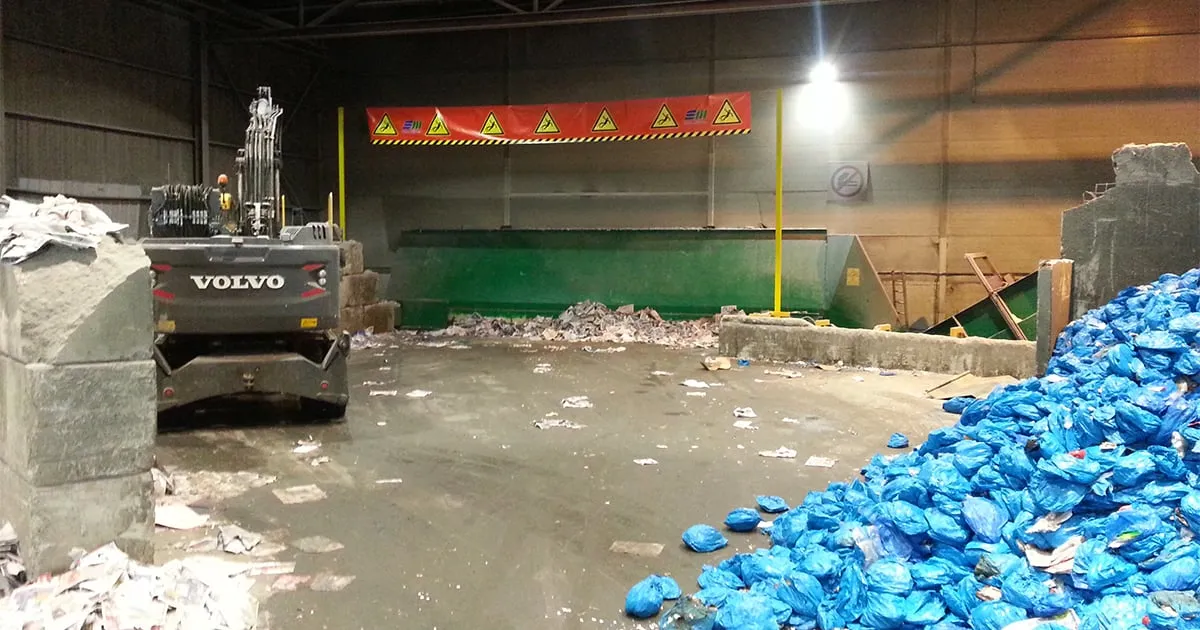
Safety at the pit conveyor – what is required
Safety requirements for recessed conveyors in waste treatment – contactless safety systems protect personnel.
Read more →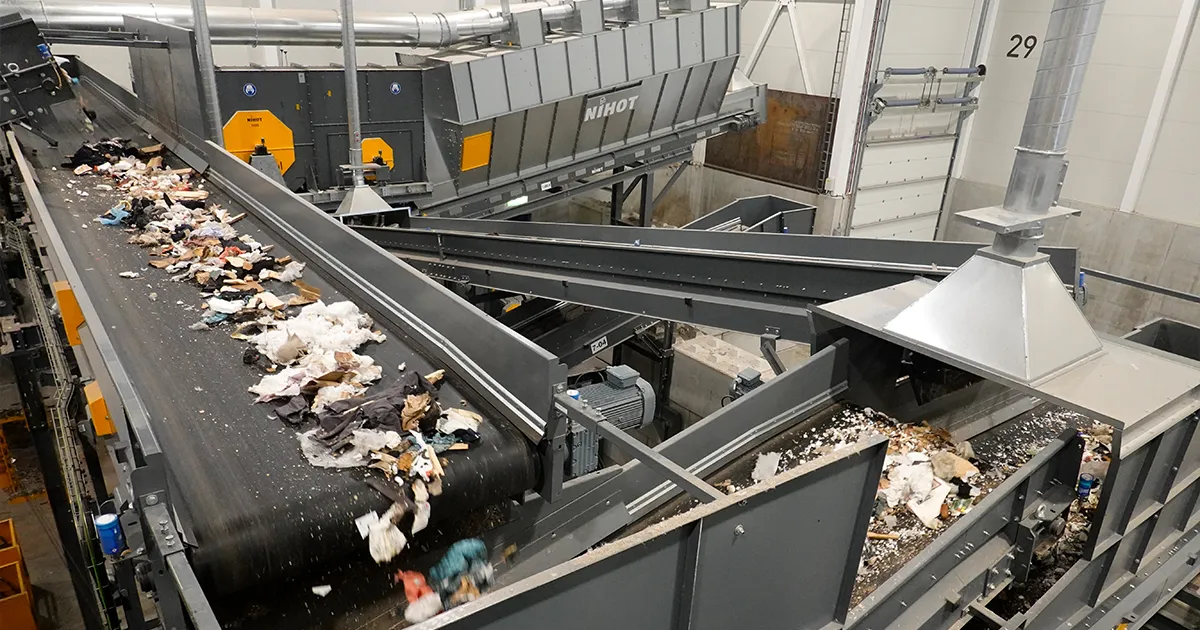
Protect the working environment: Dust extraction in waste plants
Dust control systems protect workers, increase efficiency, and meet HSE requirements in waste treatment plants.
Read more →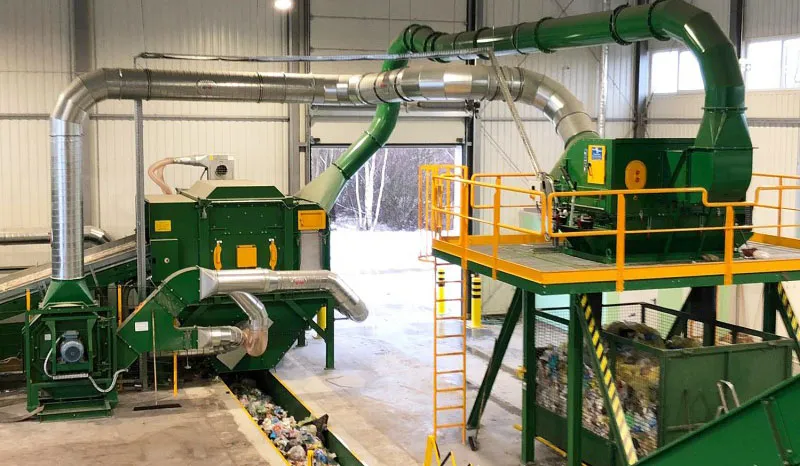
Benefits of using wind sifters and air separators in waste management
Wind sifting and air separator technology uses airflow to separate light and heavy materials for improved sorting.
Read more →