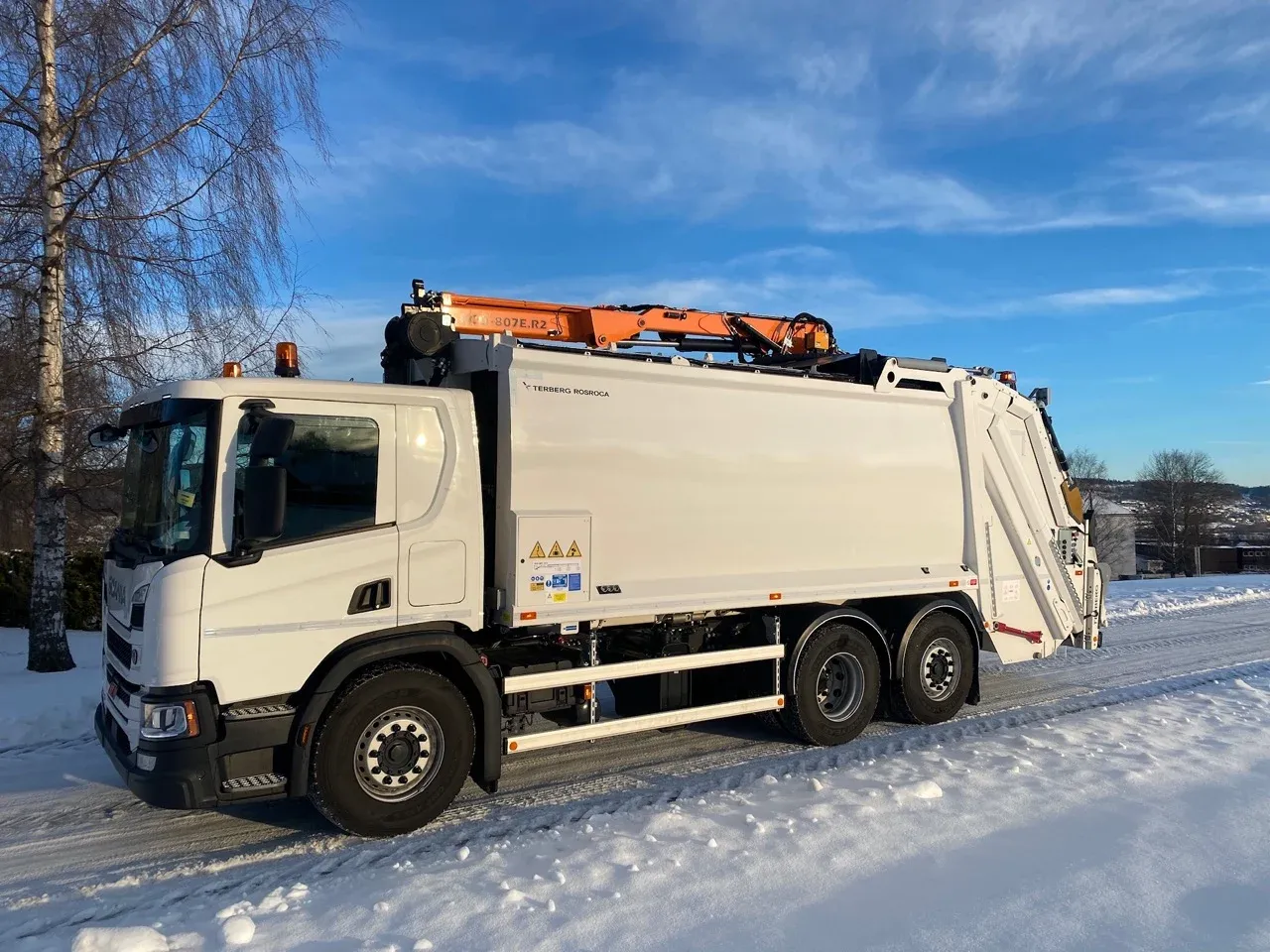
How big is a refuse collection vehicle? Dimensions, weight, and technical facts
Refuse collection vehicles come in many sizes and configurations. Whether you are an architect designing waste rooms, a municipality planning roads, or simply curious – here is an overview of the most important technical specifications.
Typical dimensions
Size varies considerably depending on vehicle type and application. Here are typical measurements for the most common categories:
| Type | Length | Width | Height | Volume (body) |
|---|---|---|---|---|
| Satellite / feeder vehicle | 5–7 m | 1.8–2.2 m | 2.5–3.0 m | 6–10 m³ |
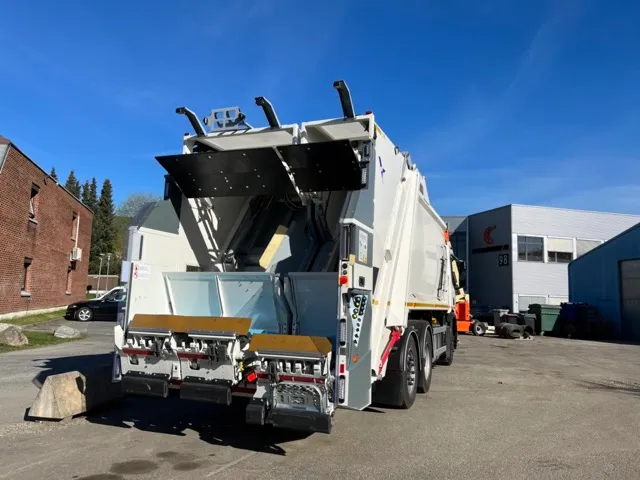
| Standard rear loader (2-axle) | 8–10 m | 2.5 m | 3.2–3.5 m | 16–22 m³ |
| Large rear loader (3-axle) | 10–12 m | 2.5 m | 3.4–3.8 m | 22–28 m³ |
| Crane vehicle (underground systems) | 9–12 m | 2.5 m | 3.3–3.8 m | 16–24 m³ |
| Side loader | 9–11 m | 2.5 m | 3.5–3.8 m | 20–30 m³ |
The 2.5 m width is the standard width for heavier vehicles. Satellite vehicles are often built on lighter chassis with narrower widths, making them suitable for narrow streets and city centres.
Weight
Weight depends on chassis type, body size, and equipment level.
| Type | Kerb weight (empty) | Gross vehicle weight |
|---|---|---|
| Satellite vehicle | 4–8 tonnes | 7.5–12 tonnes |
| Standard rear loader (2-axle) | 10–14 tonnes | 18–26 tonnes |
| Large rear loader (3-axle) | 13–17 tonnes | 26–32 tonnes |
| Crane vehicle | 12–18 tonnes | 26–32 tonnes |
The payload – i.e. how much waste the vehicle can carry – is the difference between gross weight and kerb weight. A typical 2-axle rear loader has a payload of around 8–12 tonnes, depending on configuration.
For roads and parking structures it is important to consider axle load, not just gross weight. A 3-axle refuse vehicle distributes weight better than a 2-axle, even though the gross weight is higher.
Turning radius
Turning radius is often the most important factor for architects and road planners. Typical values:
| Type | Turning radius (wall-to-wall) |
|---|---|
| Satellite vehicle | 6–8 m |
| Standard rear loader (2-axle) | 8–11 m |
| Large rear loader (3-axle) | 10–13 m |
| 3-axle with rear-axle steering | 8–10 m |
Turning radius is affected by wheelbase, axle configuration, and whether the vehicle has steerable rear axle. A 3-axle vehicle with rear-axle steering can have almost as good a turning radius as a shorter 2-axle, despite being significantly longer.
When designing waste rooms, turning areas, and access roads, one should start from the largest vehicle likely to serve the area and add margin. Municipal waste operators can advise which vehicles are used in the relevant area.
Safety and NS-EN 1501
All compacting refuse body units sold in Europe must comply with safety standard NS-EN 1501. The standard regulates design, safety features, and operator protection for the refuse body – i.e. the body, not the chassis.
What the standard covers
NS-EN 1501 sets requirements for, among other things:
- The compactor’s safety switches and emergency stop functions
- Protection against crushing hazards at the tailgate and hopper
- Noise levels and vibrations for operators
- Steps, handles, and platforms for crew standing on the outside of the vehicle
Steps and driving with crew on the rear
A common question is whether it is permitted to stand on the back of a refuse vehicle while it is driving. The answer is yes – provided the vehicle is built and approved for it in accordance with NS-EN 1501.
When crew stand on the step, a number of safety functions are activated:
- Speed limit: The vehicle cannot drive faster than 30 km/h when the step is deployed and manned.
- Reverse lock: The vehicle cannot be put into reverse, or the operator is clearly warned, depending on configuration.
- Sensors: The system detects whether someone is standing on the step and adjusts the vehicle’s behaviour accordingly.
The step design is also regulated: width, anti-slip features, attachment points, and handle placement follow the requirements of the standard. In addition to the body’s own approval, the chassis must be type-approved for use with steps and reduced speed.
Why this is safe
The combination of speed limitation, reverse lock, and robust design allows crew to work efficiently without entering and exiting the cab at every stop. It significantly reduces time per stop and is widespread practice in the waste collection industry across Europe.
Noise and emissions
Refuse collection vehicles are often the heaviest vehicles in residential areas, and noise is an important factor – especially during early morning collections.
Electric refuse vehicles
Fully electric refuse vehicles with battery-powered chassis exist but are still relatively uncommon. The noise reduction is significant: an electric drivetrain is almost silent compared with diesel.
Battery-powered hydraulics
A more common solution today is a diesel- or gas-powered chassis combined with a battery-powered hydraulic pump for body functions (compaction, lifting, hopper operation). This can be done in two ways:
- Large dedicated battery: A separate battery system powers all hydraulic functions on the body. The diesel engine is used only for propulsion.
- 24V from the chassis battery: Lighter functions such as the hopper can be powered directly from the chassis’s own 24V battery, without the need for a separate large battery system.
Both solutions significantly reduce noise and emissions during collection stops, because the diesel engine does not need to idle to power the hydraulics.
Frequently asked questions
Can a refuse vehicle reverse with people on the back? No, not as standard. When the step is manned, a reverse lock or clear warning is activated. Crew should normally step off before reversing.
How fast can a refuse vehicle drive with people on the back? Maximum 30 km/h, regulated by NS-EN 1501. In practice, speeds are typically 15–25 km/h between stops.
How much does a wheelie bin weigh? A standard 140-litre residual waste bin typically weighs 5–15 kg depending on contents. A 240-litre bin can weigh up to 30–40 kg. The hopper lifter on the refuse vehicle is rated to lift bins up to approximately 120–200 kg, depending on type.
How often is waste collected? This varies between municipalities. Residual waste is typically collected every two weeks, while paper and plastic packaging is often collected every four weeks. Commercial waste may have daily or weekly collection by agreement.
Where does the refuse vehicle empty its load? Waste is taken to a transfer station, sorting plant, or incineration plant depending on waste type and municipality.
Steco supplies refuse collection vehicles and bodies in all sizes – from compact satellite vehicles for narrow city streets to large rear loaders for demanding collection routes. We are an authorised dealer for Terberg Environmental and an approved bodybuilder workshop. Contact us for advice.

Not sure what you need?
We help you find the right solution — no obligation.