Manipulators for waste sorting – from robot arms to air jets
From robot arms to air jets
In earlier articles we looked at why robotic waste sorting pays off and how detection systems identify different materials. This article focuses on the “hands” of the system – the various manipulators that physically carry out the sorting work.
Overview of different manipulator types
Two dominant manipulator types exist in robotic waste sorting:
- Industrial robot arms – versatile and adaptable
- Air-jet systems – high-speed sorting of lighter materials
Many see robotic sorting as an alternative to existing optical sorting (NIR readers). In reality, these are two sides of the same process: an optical detection system coupled with a manipulator.
Industrial robot arms
The versatile workhorse
Industrial robot arms offer the most versatile solution for waste sorting:
- Articulated robot arms – with 6 or more axes provide great freedom of movement
- Delta robots – extremely fast, ideal for light materials
- Cartesian robots – move along three linear axes (X, Y, Z)
Advantages of commercial robot arms
Proven and mature technology: Industrial robots have been used in manufacturing for decades. Major manufacturers such as FANUC, ABB, KUKA, and Universal Robots have delivered hundreds of thousands of units. This means:
- The technology is well tested and robust
- Reliability is documented (often 100,000+ hours between failures)
- Minimal maintenance requirements
Extensive service and support networks: Established robot manufacturers offer global service networks, fast access to spare parts, and standardised training programmes.
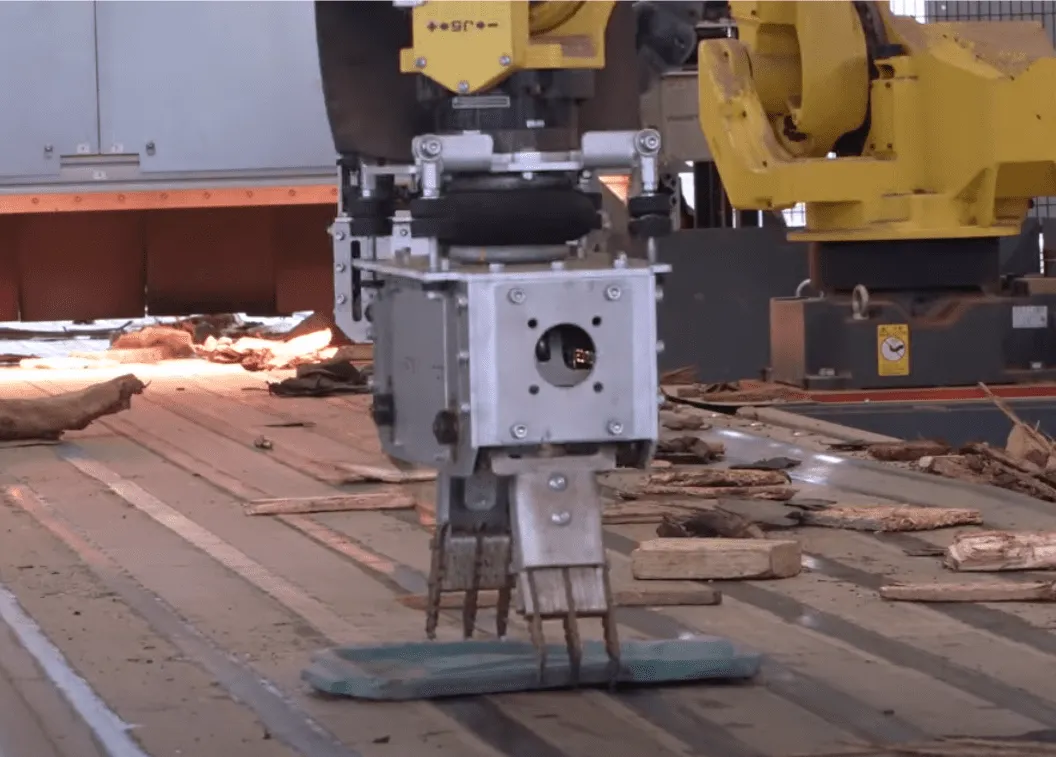
Specialised gripping tools for waste
Specialised grippers mounted on robot arms make them effective for waste sorting. Grippers for tougher materials handle objects up to 20 kg and are suited for wood, concrete, and large metal objects. Variants also exist for bags, flexible materials, and lightweight items.
Advanced gripper technology enables precise picking without disturbing surrounding material on the conveyor belt. This allows multiple robot arms in series without intermediate camera systems.
Other manipulator types
Cartesian robots
Some suppliers have developed custom Cartesian robots that move along three perpendicular axes. This mechanically simpler structure can reduce production costs but provides limited freedom of movement.
Mechanical ejectors
Simple pusher units work in bag sorting systems where coloured bags are separated from one another. Modern robot arms with AI-based detection solve similar tasks with much simpler and less expensive infrastructure.
Choosing the right manipulator
Several factors influence the choice between robot arms and air-jet systems:
- Material size and weight – Light, flat materials → air jets. Heavy, large objects → robot arms
- Production speed – Very high speed → air jets (hundreds per minute). Moderate speed → robot arms (20–60 picks per minute)
- Number of fractions – Two fractions → air jets. Multiple fractions (up to 6) → robot arms
- Material value and purity requirements – High-value materials → precise robot arms. Bulk materials → air jets
Combined solutions
Modern plants increasingly use combined approaches:
- Air jets for initial coarse sorting into two main fractions
- Robot arms for fine sorting into multiple sub-fractions
- Different manipulator types handle different material streams simultaneously
The manipulators of the future
Development is rapid. Grippers with built-in sensors adapt grip force and strategy based on the objects being picked. Most exciting is the AI potential for training the manipulator itself – developing advanced movement patterns that ensure objects reach their intended destination.
Robot arms and air-jet systems do not compete directly – they have different strengths. Combining both technologies often delivers optimal results.